There is a scene early in the 2006 mockumentary Radiant City that provides the key explanation to the morphology of suburban sprawl. Our favorite writer James Howard Kunstler sits on a bench in a community bike trail that is enclosed in two rows of chain link fence in order to, I presume, secure it from the high-capacity arterial road that runs alongside it. The experience is vaguely what it must have been like to patrol the Berlin Wall, had it been encircled by an expressway. “Some clown in an office somewhere thought this would be a good idea, that’s why it’s here,” says Kunstler. “Not because anybody really tested whether or not it would feel good to be here.”
That’s all the film has to say about why sprawl is, and in fact there is nothing more to be said. The characteristic of a sprawl city is the absence of any intelligence in design. The rest of the movie is about how and why families cope with life in this intelligence-less environment. It does that with a narrative that is refreshingly honest and modern, despite not depicting a real family. It is shot on location in the outskirts of Calgary, a city that, thanks to a highly competent planning authority and an economic boom that has attracted large numbers of new citizens, has over the last decade built new developments at supernaturally huge scale.
The new neighborhoods are for the most part built of nice buildings, nothing to write UNESCO about but approaching genuine Victorian. Contrary to the suburban cliché, houses are built to a density that is comparable to city centers, which means there is adequate public transportation available. And in compliance with new planning regulations, developers have provided big clusters of condominium buildings to serve as “affordable housing”. With this setting, the directors have avoided the social exclusion issues that sometimes get bundled up with criticisms of the suburbs. In fact here the families explain that they left the center because it had become unaffordable for either their growing family or without shame-bearing subsidization (never mind affordable housing regulation being indirect subsidization), meaning the exclusion narrative is turned backwards. These people have been pushed out of the city.
What is there left to complain about then? Not very much, still there is a general awareness that there must be something missing, yet none of the characters can pinpoint it. They deal with boredom as best they can, the local teenagers finding, as all boys have ever done, that a muddy pit is all that’s needed for endless fun. Today’s boys turn this free space into a paintball game they call “escape to Mexico”, but it’s really just cowboys and indians for the postmodern age. Their fun is interrupted by a private security patrolmen hired by the builders to patrol the private streets, but these guards turn out to be benign bordering on benevolent. Incessant chauffeuring becomes the cause of a mini-crisis as poor husband Evan is forbidden from working on his car by his emasculating witch of a wife Anne, worried that such activities will send the car to the mechanic and leave her with the entire burden of chauffeuring the family on their maddening activities schedule.
If there is one recurring theme, it is that at every point the creative control of the environment has been taken away from individuals. The kids cannot play on empty lots, the father cannot risk working on his car, the space for any meaningful personal culture has been slashed to nearly nothing. The exception to this is Anne who gets to enjoy total control of the house itself, which she obviously takes great pleasure in when deciding how each room will be laid out. At every point in the film where someone defends the choice of life in the suburbs it is either Anne or a female real estate agent involved.
As a form of passive-aggressive revenge, Evan signs up to be in a musical about suburban life where he and his male friends sing showtunes while dancing around with lawnmowers. (Lawnmowers having no utility in the postage-stamp sized lawns of the new suburbs, they are remembered in dance.) It is telling that Evan found out about the show by looking around the Internet. It is on the Internet that community and culture has exploded in the last years as the physical world has become more and more inaccessible. The Web 2.0 phenomenon has given the power to everyone to create something and express themselves, for better or worse. The Web has become a new city, and its different processes new forms of urbanism.
Sorely missing from the film, which features the opinions of architects, professors of philosophy and other intellectuals, are the opinions of the planners, politicians and developers who make this product. The planning system is as remote to the narrative as it is to people’s lives. While the complaint of the loss of citizenship implied by mass motorization is rehashed by an intellectual, what about the loss of citizenship implied by the planning process itself? All decisions about the shape of their environment has been taken long in the past, in the colorful words of Mr. Kunstler, by some clown in an office somewhere. The only thing left for citizens to do is to enjoy or hate their environment. They have been dispossessed of any power to shape it. Somewhere democracy of place was substituted for bureaucracy, and the best the citizens have been offered since is the chance to collectively shackle the bureaucrats through public design charrettes. The citizens have no more rights to create their city than citizens of Stalin’s Moscow did. That is the only aspect sprawl still has in common with Le Corbusier’s original vision for the Radiant City.
Yet the film does not reach this conclusion. If there is any conclusion, it is that everyone is helpless in the face of this seemingly unstoppable monster. As Joseph Heath says at the beginning, the critique of suburbia is the same it was two generations ago, everyone who lives in suburbia knows backwards and forwards the critique of suburbia, yet they still live there. Andrès Duany appears proposing that what sprawl needs is a grid and denser housing, yet the setting already has a grid and obviously the last thing it needs is even more houses.
A young woman states at the end, out of character, that she sees kids playing alone in suburbia and remembers her youth building giant forts with everybody in the neighborhood. I remember my happiest time growing up at the edge of the suburbs was building a treehouse on some leftover tree with the neighborhood kids. The treehouse was demolished because it was unsafe and then the tree cut down to build another house. I never saw any of those kids again.
That’s all community is, people making things together. That’s what creates the spiritual aspect of a place. Once we lose the freedom to do that, we can’t be citizens. We are just consumers of cities. Radiant City, by looking at life in suburban sprawl in its purest, best realized form, defines the right problem but fails to ask the right question. Perhaps citizenship is so far in the past that we can’t even remember to ask the question.
Radiant City
A film by Gary Burns and Jim Brown


Leon Krier's lesson in architecture
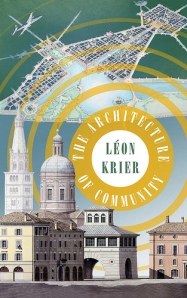
The Amazon Santa visited me this year and left Léon Krier’s latest, and likely ultimate, publication, The Architecture of Community. (Thanks to those who made generous purchases on the Emergent Urbanism Amazon Store, remember that you can also purchase anything at all.)
Back in the 1970’s when architectural modernism began to fall apart or be outright demolished, the architectural intelligentsia decided that it was okay to start using ornament again, to make buildings flashy, to take the dry structures of modern buildings and decorate them with absurd icons whose purpose was to entertain long enough that no one would notice that the architecture was still terrible. Léon Krier, a renegade amongst renegades who had no formal architectural education, had an other idea in mind: that there was such a thing as objective laws in architecture, that these laws remained unchanged over time, and that classicism was the best expression of these laws. Any other architect’s career would be destroyed by such a claim in such an era – Léon Krier just kept going, publishing article after article, book after book, until the estate of the Prince of Wales gave him his big break and commissioned the design of an entire neighborhood based upon his ideas. If there is a neo-traditionalist movement in architecture and urban design today, it is because Léon Krier imagined it first. This book is the compilation of the product of his career as an architect, but mostly as a writer.
Having read through the book, my conclusion is that Krier gives a thorough lesson in architecture, taking obvious pleasure is shredding the myths of modernism to pieces and exposing its false prophecies. However, the text never goes beyond the most superficially descriptive, often involving comparisons and an appeal to common sense. While Krier can point out, using his trademark caricatures, how absurd the patterns of modern sprawl are, he has no explanation as to why such patterns would exist, except that it may be just one big conspiracy. He has even less to say about community, which is strange considering the word is in the title. It is as if in the vocabulary of neo-traditional architects community and space have become synonymous. (Many of the great villages and towns of Europe are dying because their community is dying, regardless of their physical form.) For this reason Krier produces a very sharp lesson in architecture, but provides no insight into morphology, and cannot really develop a model of urbanism that isn’t simply architecture at enormous scale. It should be no surprise that his disciples have practiced town planning the same way.
Despite his claims of providing a plan for the post-fossil fuel age, his projects require enormous concentrations of capital to develop, the kind of capital only princes have at their disposal, and provide no guarantee of ever being home to a true community. Although he demonstrates a sensibility, if not necessarily an understanding, for chaos theory and complexity, I am left wondering if he refers to it because he finds it convenient, or because it is true. He points out that fractal geometry has denied modernism the use of abstract forms as more rational geometric objects, and many of his drawings could be used as perfect examples of complex geometry. It is however not explained why anything is depicted the way it is, or how it could be the way it is. Architectural complexity is embraced, but the leap to emergence, crucial for any practical model of urbanism, is not there.
Most of the book consists of sketches, pictures and small essays whose intent is to persuade instead of to argue, and there lies the most peculiar thing about it. It is in precisely the same format that Le Corbusier once published his works of pioneering architectural propaganda. It is as if Krier sought to turn the very arms of modernism against it, to fight evil with evil with a classical counter-propaganda. Krier knows the power that architecture can wield – his monograph on the architecture of Albert Speer (Albert Speer: Architecture, 1932-1942) remains one of the most frightening architectural books I’ve yet seen, if there can be such a thing as a frightening architecture. He exposed fascism in all of its most seductive displays, at once explaining how the movement could wield power over so many followers, and why there would be a ban against classical architecture itself in the aftermath of the war. One could read hundreds of post-war philosophers without ever arriving at such a realization. Krier believes that classical architecture is a powerful cultural force that can also be used for good, that it is absurd to deny ourself this force because it was used to evil ends, and concludes as such his review of Speer. There is nothing so epic in this new book, although Krier dedicates an entire chapter to a plan for Washington D.C. that would “complete” the city (a plan he also displays on the cover), which shows us where his loyalties lie. What he doesn’t seem to know is how dangerous the power of propaganda is, and how using it may be feeding the very process he wants to denounce.
Hence, the most problematic issue with this compendium of Krier’s career is the medium itself. Krier presents drawings of an architecture that is rationalized and purified, playing it safe in order to rebuild architecture on its foundations. The great eclectic architecture of the 19th century, and the early 20th, is left out. That does not demonstrate confidence in one’s belief in laws of architecture, and will not provide anything greater to a new generation of architects than an alternative propaganda that may tap some deeper feeling, but won’t give them any arguments against other fashions that violate the laws. It also won’t give them the confidence to radically apply the laws in order to invent architectural patterns that meet the needs of today’s society, whatever you want to call it. (Post-post-modern? Ultra-modern? Webbed?) Krier may not have realized that modern architecture is a product of such propaganda, the result of architecture no longer being practiced by artisans for the benefit of their local community, but by writers and graphic designers trying to come up with the flashiest image they can place in a magazine. The quality of the building is irrelevant if the magazines drive your business.
Much like the medium created modern architecture, the medium also created medieval and neo-classical architecture. The information technologies of Gothic churches were primitive, but extremely complex. Neo-classicism could use printing, and that made mass propagation of patterns possible to the extent that these patterns were translated into drawings. The revival of the laws of architecture that Léon Krier dreams of will likely need a new medium, one that is characteristic of our society, to be accepted as evident. Until that is invented, Krier has done us all a great service by destroying the temple of modernism, leaving at least a clean slate and the right principles to start over.